You buy a food trailer. Year one? Everything works. You’re making money. The build feels solid.
Year two arrives.
Then you notice it: a small leak near the corner where wall meets roof. Not huge, but it’s there. You call the builder—they’re unresponsive. You call local repair shops. $800-$1,500 to fix.
This scenario plays out hundreds of times per year with standard-built trailers.
Not because builders are incompetent. But because most trailers are built with a fundamental design flaw: standard wall construction has weak points by design.
There’s a better way. And understanding the difference—before you buy—could save you $5,000-$15,000 in repairs over the trailer’s lifetime.
Here’s what you need to know about Thermocore construction vs standard walls, and why it actually matters.
How Standard Walls Are Built (And Why They Fail)**
Most food trailers use the same basic construction method:
The Process:
- Aluminum or steel frame
- Insulation (fiberglass batting or foam) placed between frame studs
- Outer skin (aluminum) screwed or riveted to frame
- Inner skin (stainless steel or aluminum) screwed to frame
Sounds fine. But here’s the problem: there are gaps. Specifically, gaps at every connection point—where walls meet roof, where walls meet floor, where panels connect to each other.
These aren’t design flaws. They’re structural requirements when you build modular walls.
But modular construction = multiple seams = multiple places for moisture to penetrate.
Why This Matters:
Food trailers live in extreme conditions:
- Extreme heat (cooking equipment generates 95-110°F inside regularly)
- Extreme moisture (steam from cooking, cleaning)
- Temperature swings (hot day = cool night)
- Humidity exposure (outdoor operation)
When you have seams + extreme moisture + temperature swings, water finds its way in. Not immediately. But over months, water seeps into insulation layers.
The Timeline:
- Year 1: No visible problems. Everything seems fine.
- Year 1.5-2: Moisture accumulates in insulation. Mold begins growing inside walls.
- Year 2+: Structural problems appear. Wall deterioration. Roof leaks. Frame corrosion.
Repair cost: $2,000-$5,000+ depending on severity.
Enter Thermocore: One Monolithic Wall, Zero Weak Points
Thermocore construction is different.
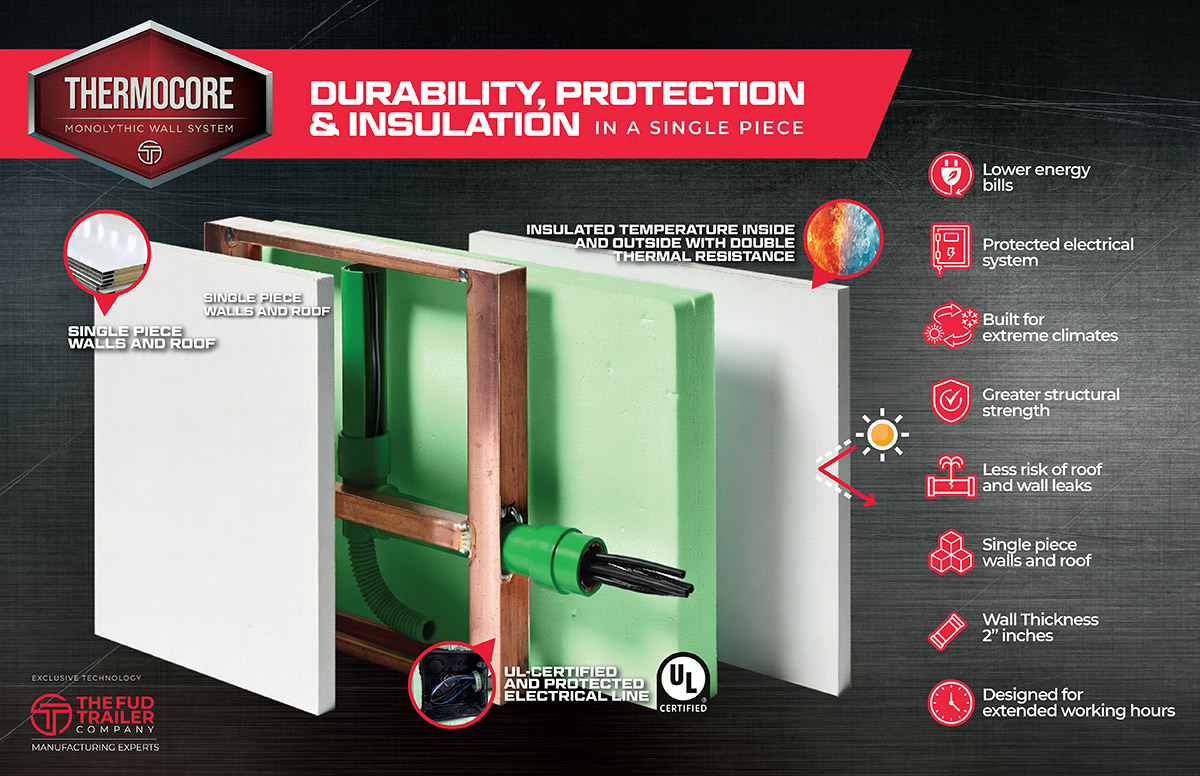
Instead of building modular walls with insulation between studs, Thermocore is one continuous panel. Think of it like a thermos bottle—not layers glued together, but one integrated structure.
How Thermocore Works:
- 2″ monolithic wall — Entire wall is one continuous foam-insulation-foam sandwich
- No internal seams — There’s literally nowhere for moisture to penetrate between layers
- Structural integrity — The wall itself is the insulation AND the structure
- UL-certified — Third-party tested for safety, durability, thermal performance
What This Prevents:
✓ No moisture accumulation in wall cavities
✓ No mold growth inside insulation
✓ No frame deterioration from water exposure
✓ No roof leaks from wall-roof connection failures
✓ No thermal bridging (where heat escapes through metal studs)
The Difference in Real Terms:
Standard trailer after 3 years of heavy use: wall damage, roof issues, potential frame corrosion.
Thermocore trailer after 3 years: zero structural wall problems.
The Numbers: Thermocore Investment vs Year-2 Repair Costs
Let’s talk budget.
A Thermocore-built trailer costs more upfront than a standard build. We’re honest about that.
But here’s what you’re actually comparing:
Scenario A — Standard Wall Trailer:
- Purchase price: $18,000
- Year 2 repairs (wall damage, leak, mold remediation): $3,000-$5,000
- Year 3-4 repairs (frame, roof, ongoing): $2,000-$3,000
- Total 4-year cost: $23,000-$26,000
- Downtime: Weeks (repairs take time)
Scenario B — Thermocore Trailer:
- Purchase price: $20,500
- Year 2 repairs: $0-$500 (routine maintenance only)
- Year 3-4 repairs: $0-$300
- Total 4-year cost: $20,800-$21,300
- Downtime: None (no major failures)
The Thermocore trailer costs $2,500 more upfront. But saves $3,000-$5,000 in repairs over 4 years, plus eliminates downtime.
That’s not premium pricing. That’s smart investment.
The UL Certification: What It Actually Means
Thermocore is UL-listed. Standard walls typically aren’t.
UL certification means:
- ✓ Independent third-party testing (not manufacturer claims)
- ✓ Thermal resistance verified (insulation actually works)
- ✓ Durability tested under extreme conditions
- ✓ Safety standards met (electrical integration, fire safety)
- ✓ Consistency (every Thermocore unit meets spec)
Standard walls? No third-party verification. Quality varies by manufacturer. No independent proof of durability.
When you finance a trailer, lenders see UL-certified construction as lower risk. Some financing partners even offer better rates for UL-certified units because failure rates are demonstrably lower.
The Hidden Benefit: Energy Efficiency Translates to Profit
Thermocore’s 2″ monolithic wall isn’t just stronger. It’s more insulated.
Better insulation means:
- Your AC doesn’t have to work as hard (lower energy bills)
- Your cooking equipment runs more efficiently
- You can operate longer during hot seasons without overheating
Real example: Thermocore trailer in Phoenix summer heat = $200-$300/month saved in energy vs standard trailer.
Over a year: $2,400-$3,600 in savings.
That’s not theoretical. That’s profit.
The Warranty Difference: What They Won’t Tell You**
Most standard-wall trailers come with 1-2 year structural warranties.
Thermocore units come with longer, more comprehensive warranties specifically because structural failures are rare.
Here’s what that means: if you buy a standard trailer and experience wall problems in year 3, you’re out of warranty. You pay for repairs.
Thermocore? Longer coverage because the manufacturer has confidence the walls won’t fail.
It’s a telling difference.
The Real Question: Why Don’t All Trailers Use Thermocore?**
Valid question.
Answer: Cost and manufacturing complexity.
Thermocore requires specialized equipment and precision manufacturing. Standard wall construction is simpler—literally just frame + insulation + skin.
Some manufacturers choose cheaper construction to compete on price. They know their trailers will have issues in year 2-3, but by then they’ve already sold them.
The Fud Trailer Company chose different: invest in certified construction upfront, build trailers that last, support customers for years.
Conclusion: Your Year-2 Self Will Thank You**
When you’re buying a food trailer, the price difference between standard and Thermocore seems significant.
Then year 2 arrives.
Your friend with the standard trailer is dealing with wall leaks, moisture problems, potential mold. He’s calling contractors. He’s spending money on repairs. He’s frustrated.
You’re operating smoothly. No structural issues. Minimal maintenance. Profit flowing.
That’s the difference between building for price and building for durability.
Thermocore costs more upfront. But it saves money, headaches, and downtime over the life of your business.
That’s not premium construction. That’s smart construction.
Ready to build smart, not cheap?
Every Fud Trailer comes with Thermocore construction standard. No compromises on durability, no surprises in year 2.
Get Pre-Approved for a Thermocore Trailer Today →
Talk to a Real Fabricator About Construction →
Your future self will thank you.